
Viruses Built to Target
Rajeevkumar Raveendran Nair at the Kavli Institute of Neuroscience has received NOK 1 million to further develop transport viruses that can transport gene-therapy drugs, but only activate them in specific cells. EDGE-Tx is the virus that may become an important tool in the fight against Alzheimer’s disease.
Text and photo: Per Steinar Moen
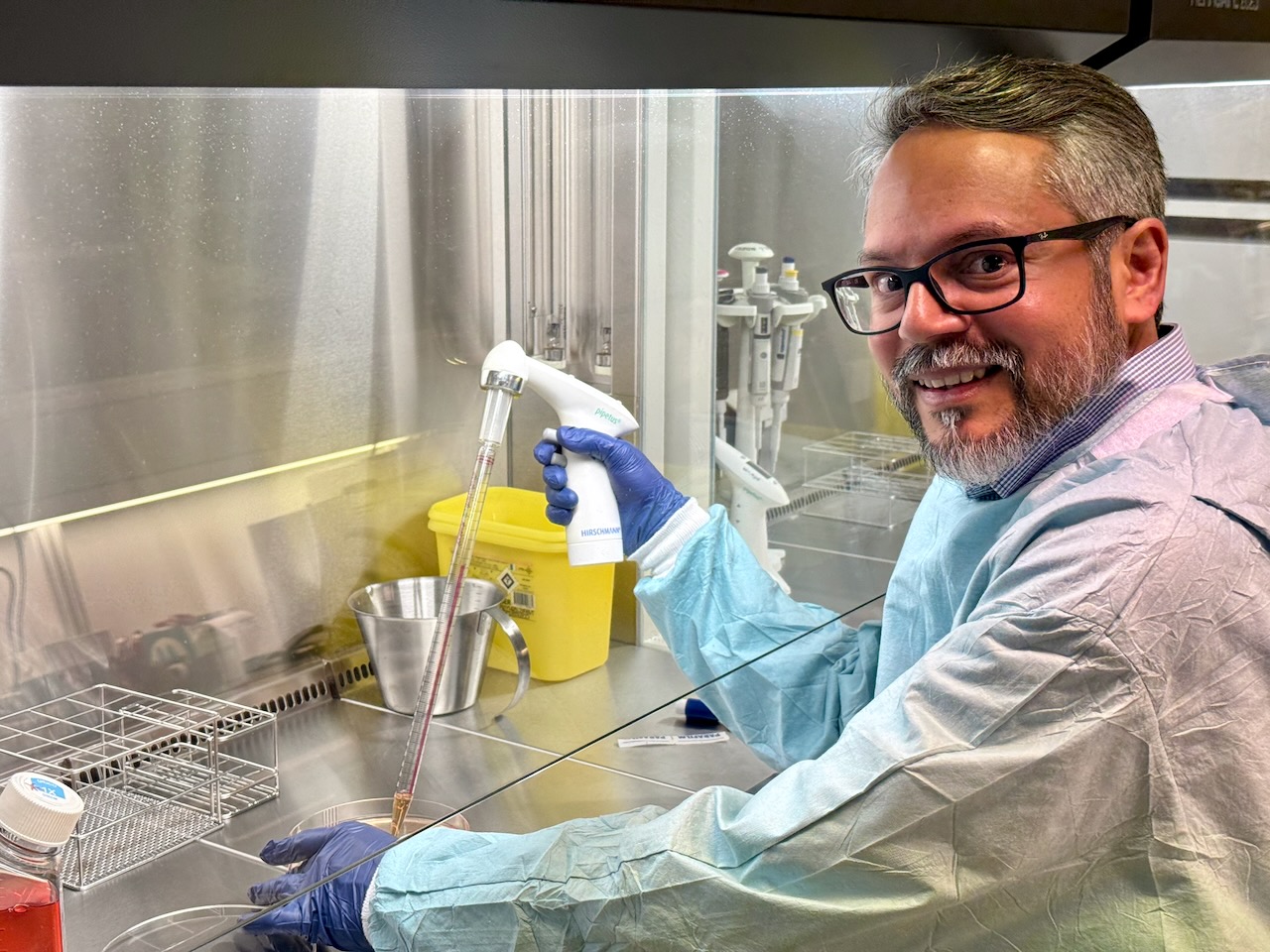
“Do not cross!” The message written along the red lines on the floor is impossible to misinterpret. Above one of the lab stations, a sign reads: “For rabies virus.” Bioscientist Rajeevkumar Raveendran Nair leads us into the virus factory at the Kavli Institute. He is used to people are reacting to the fact that he works on developing viruses. “Rabies scares people,” Nair says, “but viruses are an incredible tool for neuroscience.”
Viruses are genetic parasites that attach themselves to cells and cause them to read the virus’s genes as if they were the cell’s own. In doing so, they reprogram the cell to, for example, produce new copies of the harmful virus—while the cell ultimately destroys itself. For living organisms, this is usually bad news. But the parasite-like properties of viruses can also be used for purposes beyond causing disease and death.
Nair drips red-colored cell culture into a petri dish—an early step in growing cells capable of producing new viruses. “Not all viruses are villains,” he says. In the laboratory, Nair spends about half of his working day producing so-called viral vectors: engineered viruses that have been modified (including the removal of all disease-causing genes) and can now be used to insert new genes into cells. The virus factory at the Kavli Institute supplies such viral vectors to hundreds of research laboratories in 20 different countries, and they have become a key component of modern gene therapy, a field that has rapidly advanced over the past 20 years. “Viruses are perfect vehicles for delivering genes, and this is no longer science fiction,” Nair insists.
Severe side effects
In this laboratory, together with his collaborators at the Kavli Institute, Nair has developed EDGE-Tx, a biotechnology breakthrough that may become an important piece in the fight against Alzheimer’s disease.
Alzheimer’s is a fatal, incurable brain disease that leads to dementia. The disease primarily affects older people, and in Norway, 3 out of 100 individuals over the age of 65 have Alzheimer’s. The growing elderly population is also producing a growing wave of Alzheimer’s patients. After diagnosis, patients live between 4 and 10 years, often requiring extensive care and support.
In Alzheimer’s disease, the process begins in specific neurons located in a part of the brain that is crucial for memory and spatial navigation, before spreading to other regions of the cerebral cortex. The disease is characterized by malfunctions involving two different proteins: tau and amyloid beta. One operates outside the cells and destroys the connections between neurons, while the other accumulates inside the cells and damages the brain cell itself. In theory, the disease could be kept under control by regulating these proteins, but that is easier said than done.
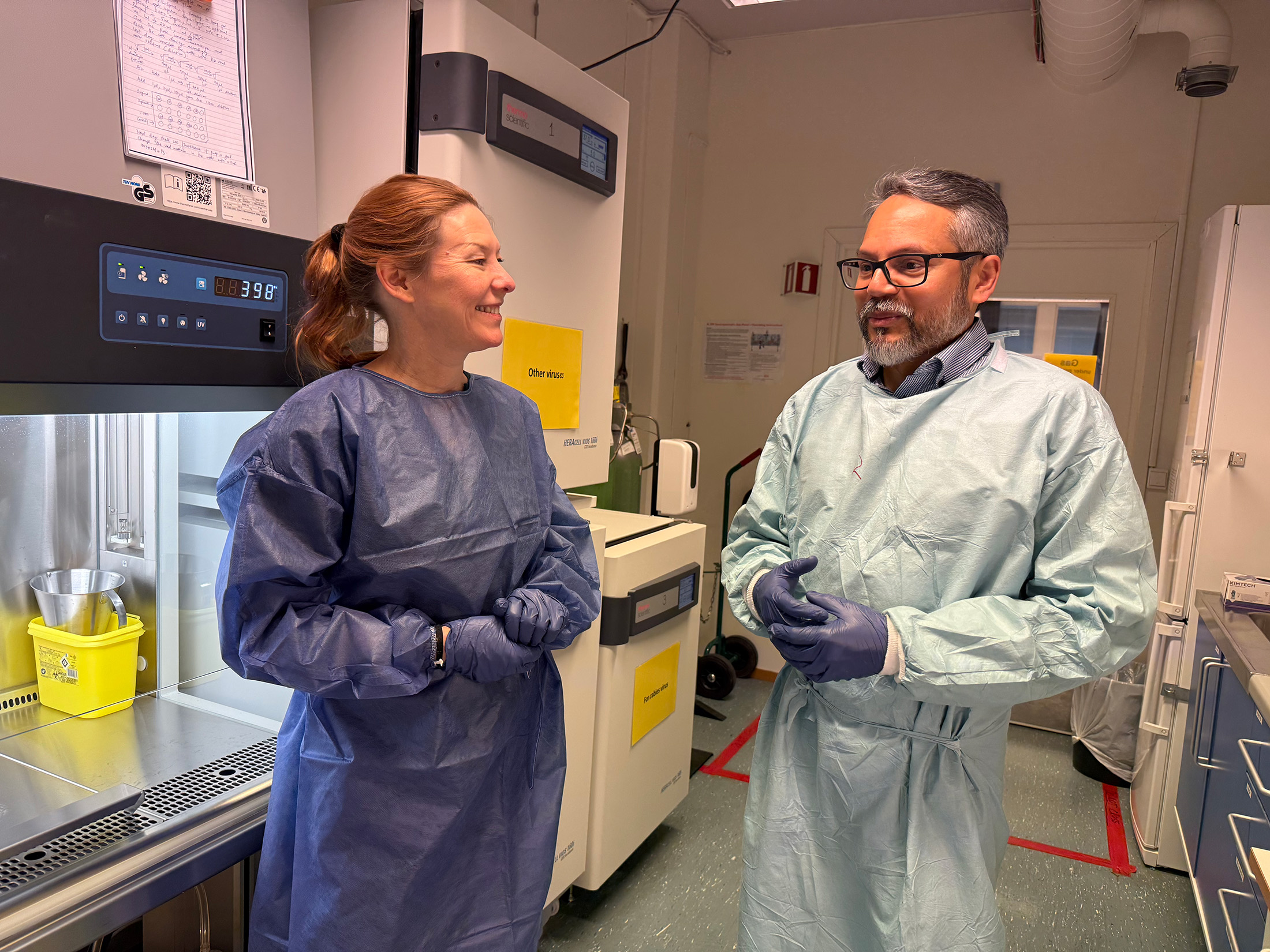
Business developer Annelene Dahl from NTNU TTO and researcher Rajeevkumar Raveendran Nair at the Kavli Institute.
Annelene Dahl is a former entrepreneur and now works as a business developer at NTNU Technology Transfer (TTO). TTO has more than 20 years of experience commercializing research results from NTNU and the Central Norway Regional Health Authority, and works to ensure that promising technology and research are developed into products and services that benefit society. Dahl also has a background as a researcher at the Kavli Institute, and is now assisting Nair in the commercialization of EDGE-Tx. This includes, among other things, guiding the new virus through a patenting process, with the goal that the technology can eventually be licensed to actors in the pharmaceutical industry.
She explains that drugs currently being developed to treat Alzheimer’s by regulating these two proteins have serious side effects. “These proteins are necessary throughout the brain,” she says. “You are trying to affect a small part of the brain where the problems start, but you end up affecting large regions where you actually need them.”
A Larger Cargo Space
EDGE-Tx addresses this problem by targeting gene therapy only to the cells in a small region of the brain that serves as the epicenter of Alzheimer’s disease. A targeting mechanism ensures that only certain cells respond and activate the virus’s genetic material.
The viral vector has been under development at the Kavli Institute for many years, but only recently have the researchers succeeded in improving the genetic targeting mechanism—meaning the DNA sequences that control where and when the genes are activated—so that space can be freed up for larger therapeutic genes. In other words, the “viral van” has now become large enough to carry a bigger genetic payload.
“Our strategy is to use these viral vectors to deliver treatment only to the cell populations where these diseases begin. The goal is, for example, to deliver a functional copy of damaged genes in the diseased cells, so they can restore function,” says Nair.
The project previously received NOK 200,000 in preliminary funding from NTNU Discovery, and has now received NOK 1 million for further validation and development. The funding will be used to test EDGE-Tx in so-called mouse models—laboratory mice genetically modified to mimic Alzheimer’s disease in humans.
“NTNU Discovery is important for projects like this, because they often require substantial development and validation before they can be commercialized,” says Dahl. Nair agrees. “Support from NTNU Discovery also makes it easier for us to access other research and commercialization funding,” he says.
Other news
Small molecule on a big mission
A research group at NTNU, led by chemists Eirik Sundby and Bård Helge Hoff, has received NOK 1 million from NTNU Discovery to further develop Revie-001, a small molecule they hope will revolutionise the treatment of ALS and other serious nerve diseases.
Muting rooms with mushrooms
The founders of Demp believe that the mushroom's root network can be used in everything from soundproofing panels to replacing asphalt.
Contact us:
Project manager
Jan Hassel
E-mail: jan.hassel@ntnu.no
Phone: 906 53 180
Office: Main building, plinth
Håvard Wibe
E-mail: havard.wibe@ntnu.no
Phone: 41 47 37 68
Office: Main building, plinth