
Reducing costs in the cloud
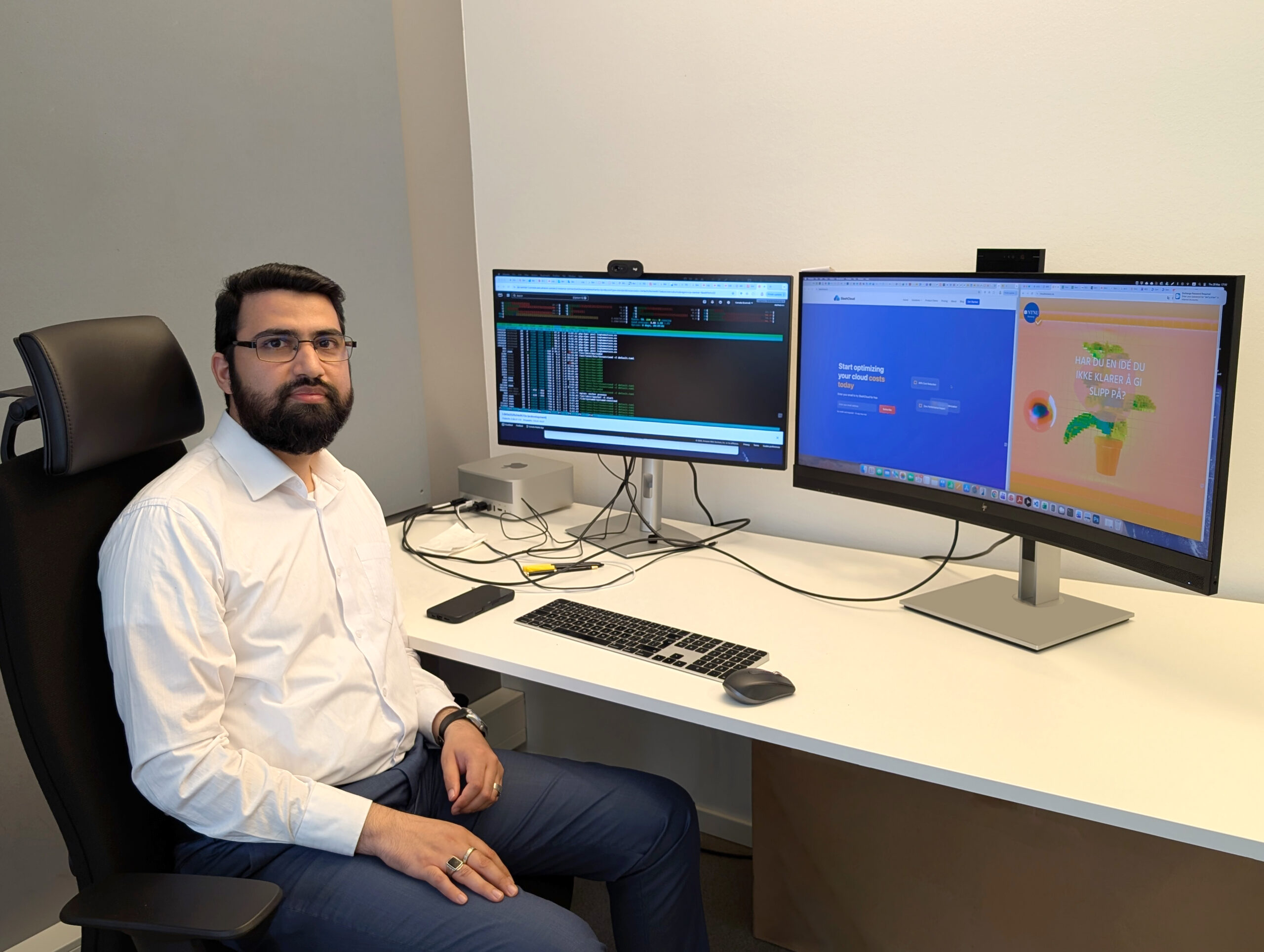
Caption: Akif Quddus Khan is developing and testing a new solution to reduce the cost of cloud services (Photo: Anders Aune / TTO)
Companies are moving more and more data and computing power to cloud services such as Azure, Amazon Web Services and Google Cloud. Akif Quddus Khan at the Department of Computer Science has now received NOK 1 million from NTNU Discovery to further develop and test a solution that will reduce the costs of using such services.
Text: Per Steinar Moen
Companies are moving more and more data and computing power to cloud services such as Azure, Amazon Web Services and Google Cloud. Akif Quddus Khan at the Department of Computer Science has now received NOK 1 million from NTNU Discovery to further develop and test a solution that will reduce the costs of using such services.
SlashCloud.io is a new service developed by NTNU researcher Akif Quddus Khan. He came up with the idea when he was a student on the Applied Computer Science master’s program at NTNU. Although he has previously worked on developing applications, the use of research methodology was a revelation.
“It was very interesting to see how you could take problems down to a basic, theoretical level and then propose new concepts that were not yet proven,” he says.
With support from NTNU Discovery, Akif Quddus Khan is developing and testing a solution that will make cloud services both cheaper and more efficient. SlashCloud.io uses mathematical methods to calculate and optimize the use of cloud resources.
There are three areas in particular that Khan wants to optimize: use of different storage options, use of computing power and moving data.
For example, data is often uploaded to relatively expensive storage without being moved to cheaper solutions when the need for access and speed decreases. SlashCloud.io should be able to automatically move data to cheaper alternatives, while taking into account the performance and costs of network usage.
There are already solutions that give businesses insight into cloud spending, but many are limited to one platform and are not automated. Unlike some new solutions on the market, SlashCloud.io is not driven by AI, but based on mathematical models that require far less computing power.
“Training and using an AI model is expensive,” he says. “Increasing costs to make a decision to reduce costs is inefficient.”
The SlashCloud.io framework is based on pure mathematical calculations, which take about one second to complete, while AI models use far more time and resources.
With funding from NTNU Discovery, Khan has been able to bring in a development team with backend and frontend developers and a designer. The prototype is now being further developed and tested, while Khan is also looking for pilot users. This is important in order to understand how the solution can be used by companies with strict requirements for security, privacy and internal guidelines.
Khan is assisted by business developer Anders Aune at NTNU TTO. Aune describes the project as an efficient and modern way to move from research to possible commercialization.
“The project is about testing the concept, almost like a lean startup method. This would not have been possible with regular research funding. At the same time, the project is firmly rooted in research methodology, and that’s an important part of the potential competitive advantage,” says Aune.
Other news
Eight million for new main projects
NTNU Discovery awarded almost NOK 8 million to employees and students affiliated with NTNU and Helse Midt-Norge.
Small molecule on a big mission
A research group at NTNU, led by chemists Eirik Sundby and Bård Helge Hoff, has received NOK 1 million from NTNU Discovery to further develop Revie-001, a small molecule they hope will revolutionise the treatment of ALS and other serious nerve diseases.
Contact us:
Project manager
Jan Hassel
E-mail: jan.hassel@ntnu.no
Phone: 906 53 180
Office: Main building, plinth
Håvard Wibe
E-mail: havard.wibe@ntnu.no
Phone: 41 47 37 68
Office: Main building, plinth