Small molecule on a big mission
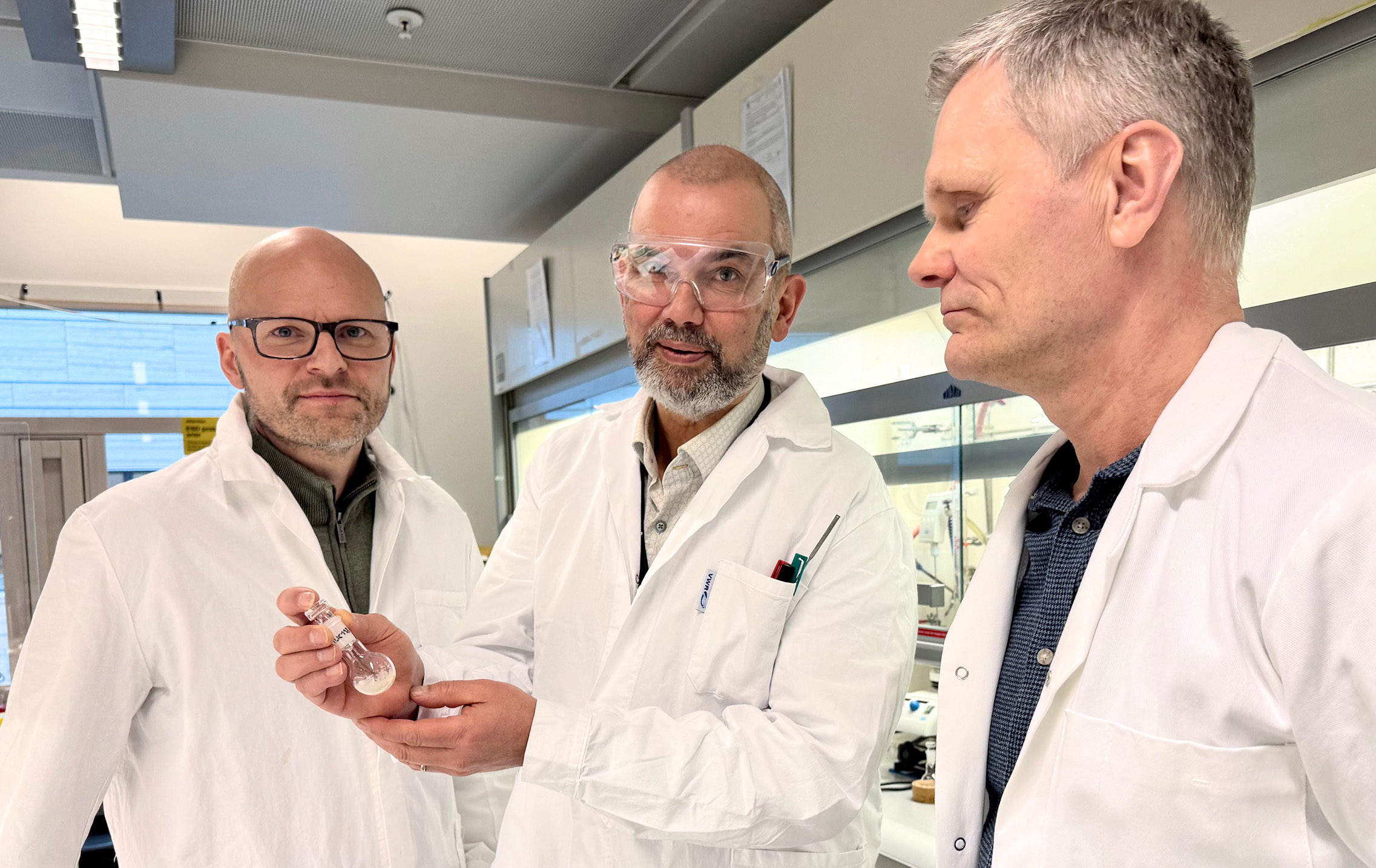
Image: NTNU chemists Bård Helge Hoff and Eirik Sundby with business developer Gaute Brede (NTNU TTO).
A research group at NTNU, led by chemists Eirik Sundby and Bård Helge Hoff, has received NOK 1 million from NTNU Discovery to further develop Revie-001, a small molecule they hope will revolutionise the treatment of ALS and other serious neurological diseases.
Text and photo: Per Steinar Moen
Sundby holds up a test tube containing a few milligrams of a light-coloured substance at the bottom. After several days of intensive laboratory work involving synthesis and purification, the molecule’s next destination is the brains of laboratory mice in Germany.
“This is one of 350 molecules we have developed,” says Sundby.
For six to seven years, he and his colleague Hoff have worked on a series of molecules they hope will reduce inflammation in the central nervous system. The series showed promise, but an entirely new series, consisting of only a few molecules, has already caught up with the development of the hundreds they previously tested. “There are probably some inherent properties in this class of compounds that make them somewhat difficult — we understand some of it, and some we don’t,” says Hoff.
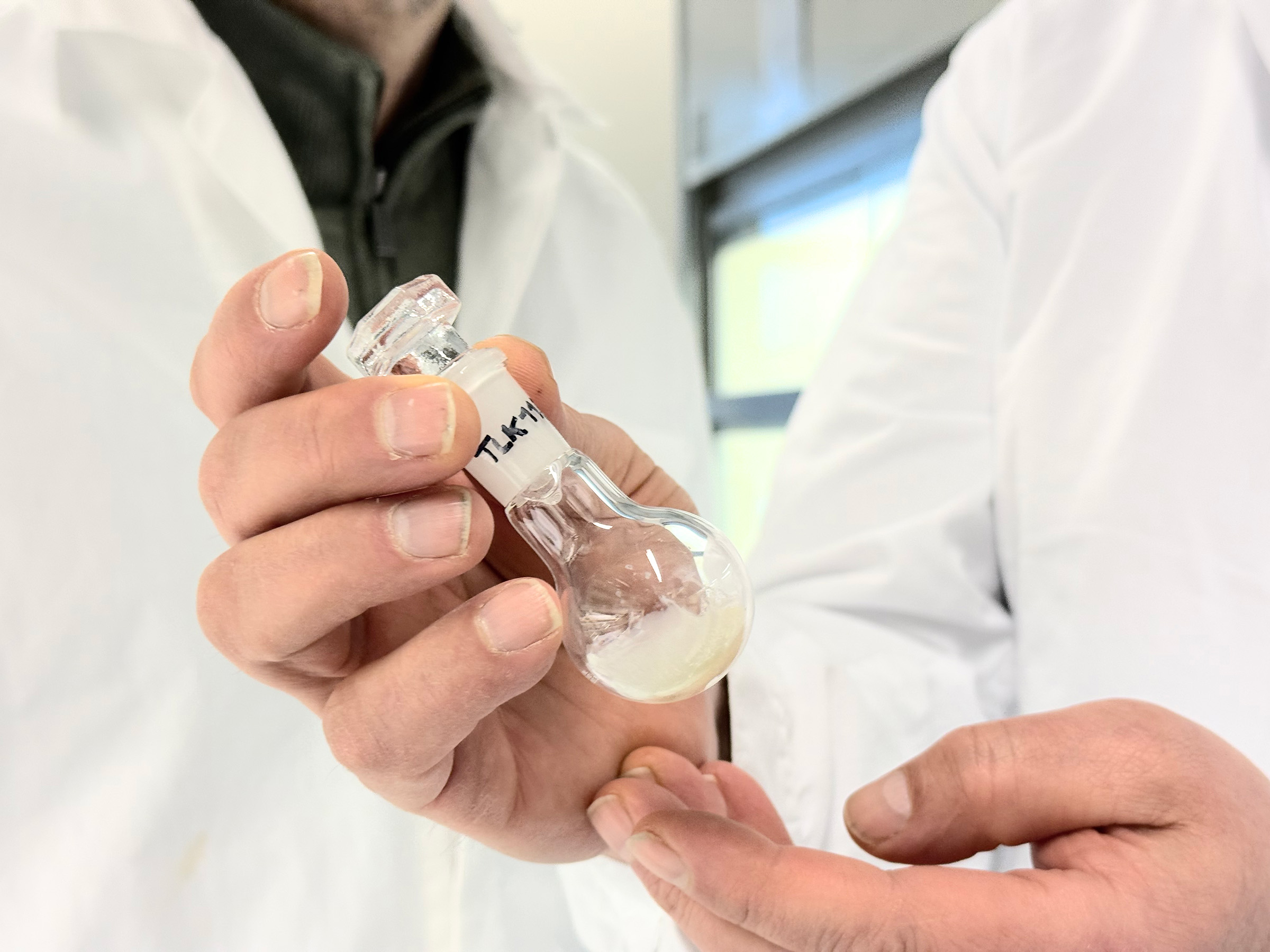
A few milligrams of the molecule Revie-001 are about to be tested in laboratory mice.
Their most promising molecule, Revie-001, will now be tested as a drug candidate against ALS, a rare, fatal neurological disease that slowly but relentlessly robs people of the ability to move. The body fails bit by bit, while the mind remains clear. Despite decades of intensive research, there is still no treatment that can stop or reverse the brutal progression of the disease.
Sundby and Hoff have collaborated since their student days and specialise in designing small molecules that can interact with proteins. Their work lies at the intersection of organic chemistry and biochemistry. Hoff says they early on sought a greater purpose in what they were doing. Could the molecules they create be used for something beyond driving chemical reactions in a laboratory?
In 2013, they won the Gullegget idea competition organised by NTNU TTO. They received NOK 1 million for their work on developing kinase inhibitors that can stop uncontrolled cell growth in cancer. “With that funding, we were in a position to focus fully on drug development,” says Sundby. Hoff recalls the reaction from their students: “They were highly motivated by the transition from pure chemistry to a combination of chemistry and drug development.”
“Can you try to explain what the Revie-001 molecule does so that the whole world can understand it?” asks the journalist without a scientific background.
“It’s a heterocyclic compound!” Hoff exclaims, leaving the sentence hanging. Sundby continues more pedagogically: “It’s an inhibitor. The molecule inhibits a cellular signal,” he says. Diseases such as ALS, MS and Alzheimer’s lead to destructive inflammatory conditions in the central nervous system. Microglia are immune cells in the brain that are necessary for clearing debris and removing cellular waste. In patients with these diseases, these immune cells become overactive. This permanently damages nerve cells and accelerates disease progression. Revie-001 tempers a key factor involved in the activation and survival of these cells.
It may sound simple, but this is a difficult task for a heterocyclic compound. The drug is taken orally, absorbed into the bloodstream from the digestive system, and distributed throughout the body. To reach the affected parts of the brain, the molecules must cross the blood–brain barrier — an effective filter between the blood and brain tissue that has evolved to protect the brain from toxins, bacteria and foreign molecules. “It is a major barrier for such small molecules to enter the brain,” says Sundby. But Revie-001 manages to slip through. “We see good brain penetration,” he states.
In the brain, the molecule appears to reduce overactive microglia, at least in mouse brains. So far, Revie-001 has been tested in various mouse models for MS and ALS, with very promising results. “Revie-001 targets the intended cells, and the mice tolerate the treatment,” Hoff concludes.
Developing a new drug and understanding how a molecule works in a model organism (such as mice) is far more complex than understanding what happens in a simple test tube — and it is highly resource-intensive.
“We therefore established early on a collaboration with a leading international player in early-stage drug development, testing and commercialisation, the Lead Discovery Center (LDC) in Dortmund,” says Gaute Brede, business developer and project lead at NTNU TTO. He supports the researchers in a demanding and long-term commercialisation process.
The centre, with nearly 90 researchers specialising in early-stage academic projects, has methods and testing systems that enable NTNU researchers to move faster towards their goal: making Revie-001 attractive to larger pharmaceutical companies.
By entering this collaboration with LDC, they secured approximately NOK 18 million from a fund (the KHAN-I fund) associated with LDC. “It is also about speed and competition,” says Brede.
He is full of praise for the two chemists. “They have been extremely skilled at designing and synthesising pure, high-quality compounds that LDC collaborators could use directly in their work. There are many parameters to consider in getting a small molecule to hit exactly the right target in the brain — and preferably nothing else,” says Brede.
The funding from NTNU Discovery will be used for further animal studies in mice. The next phase is to test the drug candidate in an alternative disease model for ALS that is relevant to a larger proportion of patients. A breakthrough in this model will determine whether there is a basis for further clinical development and investment. If results are positive, further development and commercialisation will need to be carried out by a larger industrial partner under licence from NTNU. In this way, research and knowledge from NTNU can contribute to potentially new medicines with significant societal benefit.
“NTNU Discovery puts us in a position to take an important step forward,” says Sundby. “It is not unrealistic that we could run the first clinical trial in patients within not too many years.”
So far, Sundby and Hoff have “burned through NOK 30–40 million”, but that is relatively little in this context, and much more funding is needed.
Hoff has no doubt that this is their opportunity. “It will be hard to get this close to bringing a drug to market again … before we hang up,” says the 54-year-old.
Other news
Reducing costs in the cloud
Companies are moving more and more data and computing power to cloud services such as Azure, Amazon Web Services and Google Cloud. Akif Quddus Khan at the Department of Computer Science has now received NOK 1 million from NTNU Discovery to further develop and test a solution that will reduce the costs of using such services.
Eight million for new main projects
NTNU Discovery awarded almost NOK 8 million to employees and students affiliated with NTNU and Helse Midt-Norge.
Contact us:
Project manager
Jan Hassel
E-mail: jan.hassel@ntnu.no
Phone: 906 53 180
Office: Main building, plinth
Håvard Wibe
E-mail: havard.wibe@ntnu.no
Phone: 41 47 37 68
Office: Main building, plinth