
Muting rooms with mushrooms
Demp founders Guro Stålstrøm and Helle Skog Christiansen believe that the mushroom’s root network can be used in everything from soundproofing panels to replacing asphalt.
Text: Per Steinar Moen
Photo: Kristoffer Wittrup
Right at the reception of E. C. Dahls Eiendom in the old Merkur center hangs something that to the uninitiated may resemble an abstract work of art, delicately framed and stylishly spotlit as if it were hanging in a gallery (the association is further reinforced when the receptionist mentions that an “artist” was responsible for the installation). In reality, the installation is something as ordinary as acoustic panels, plates that are attached to ceilings and walls to dampen sound.
Where other types of acoustic panels are made from petroleum, glass wool, artificial adhesives and concrete, Demp acoustic panels are made from, and with, nature.
The panels are bound together by mycelium, the fungi’s root network, which is usually well hidden beneath the surface of the soil. Mycelium consists of a dense network of hyphae, tiny threads of cells, which spread out in all directions, eventually enveloping the material it grows in. Need more mycelium? Just let it grow.
“Just like sourdough,” says Helle Skog Christiansen, CEO of Demp. “You take a little and then you feed it.”
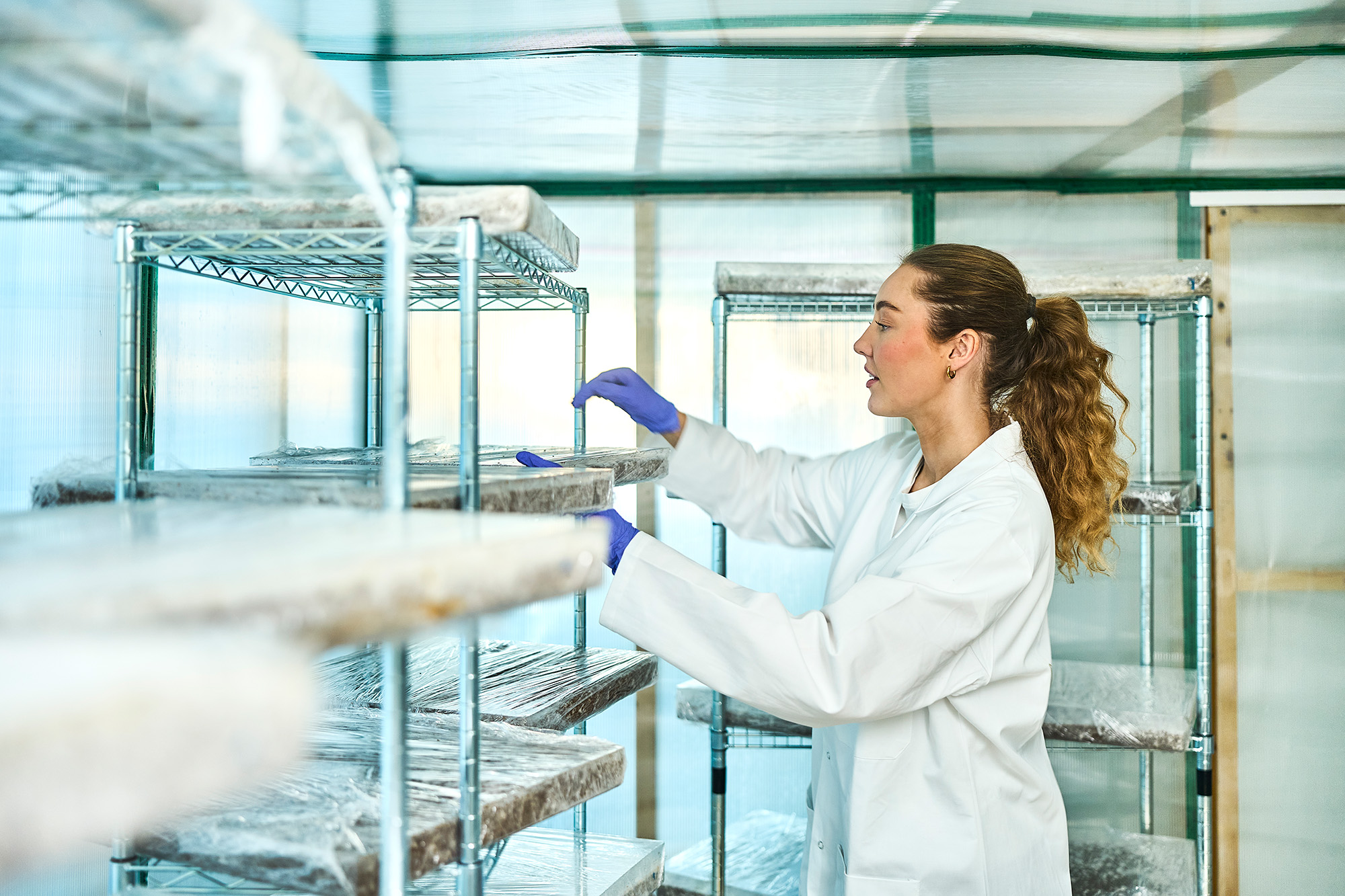
Helle Skog Christiansen stacks the panels vertically. They are carefully monitored with sensors to ensure controlled growth.
Christiansen is the “artist”, as the receptionist called her. Since 2024, she has headed Demp, a start-up company from the School of Entrepreneurship at NTNU, which she founded together with Guro Stålstrøm.
E. C. Dahls Eiendom is Demp’s first major customer. The real estate company has 108 different properties in the center of Trondheim, including the new magnificent buildings Nye Hjorten and PoMo. The acoustic panels have been place in a room right next to the reception. Stålstrøm is very pleased to receive support from a major real estate developer. “We hope that it will send a signal to other customers,” says Stålstrøm.
The idea for Demp was conceived during the feasibility studies at the business school. Stålstrøm and Christiansen watched the documentary “Fantastic Fungi” on Netflix. “I remember we thought this is cool, we have to do something about this,” says Christiansen.
With a background in business development from NTNU’s School of Entrepreneurship, they started the company. They were later joined by biotechnologist Cedric Langeweg, who has been crucial in developing the production method.
Together, they realised that acoustic panels could be a good start for developing the mycelium technology. The product is a link between architecture, interior design and technology, operating in an industry that has a willingness to pay and incentives to invest in sustainable solutions.
Christiansen says that the acoustic panels with mycelium solve two things. “It enhances the interior, it looks like art”, while at the same time “it is sound absorbing”. Stålstrøm adds: “And it’s sustainable and biodegradable”.
The acoustic panels are just the beginning for the use of mycelium, according to the Demp founders. “Our dream is to become an enabler for mycelium technology,” says Christiansen. “There are so many possibilities. We think there’s a lot of potential in the material itself.” She believes mycelium can replace plastic and polystyrene in packaging, be used as a building material in flooring or insulation, or as a textile or leather, “even in asphalt”, she says.
During a few autumn months in 2024, they received funding for both the pilot project and the main project from NTNU Discovery, a total of NOK 375,000. Last year, they were also awarded the Student Million from Innovation Norway. The money has come in handy.
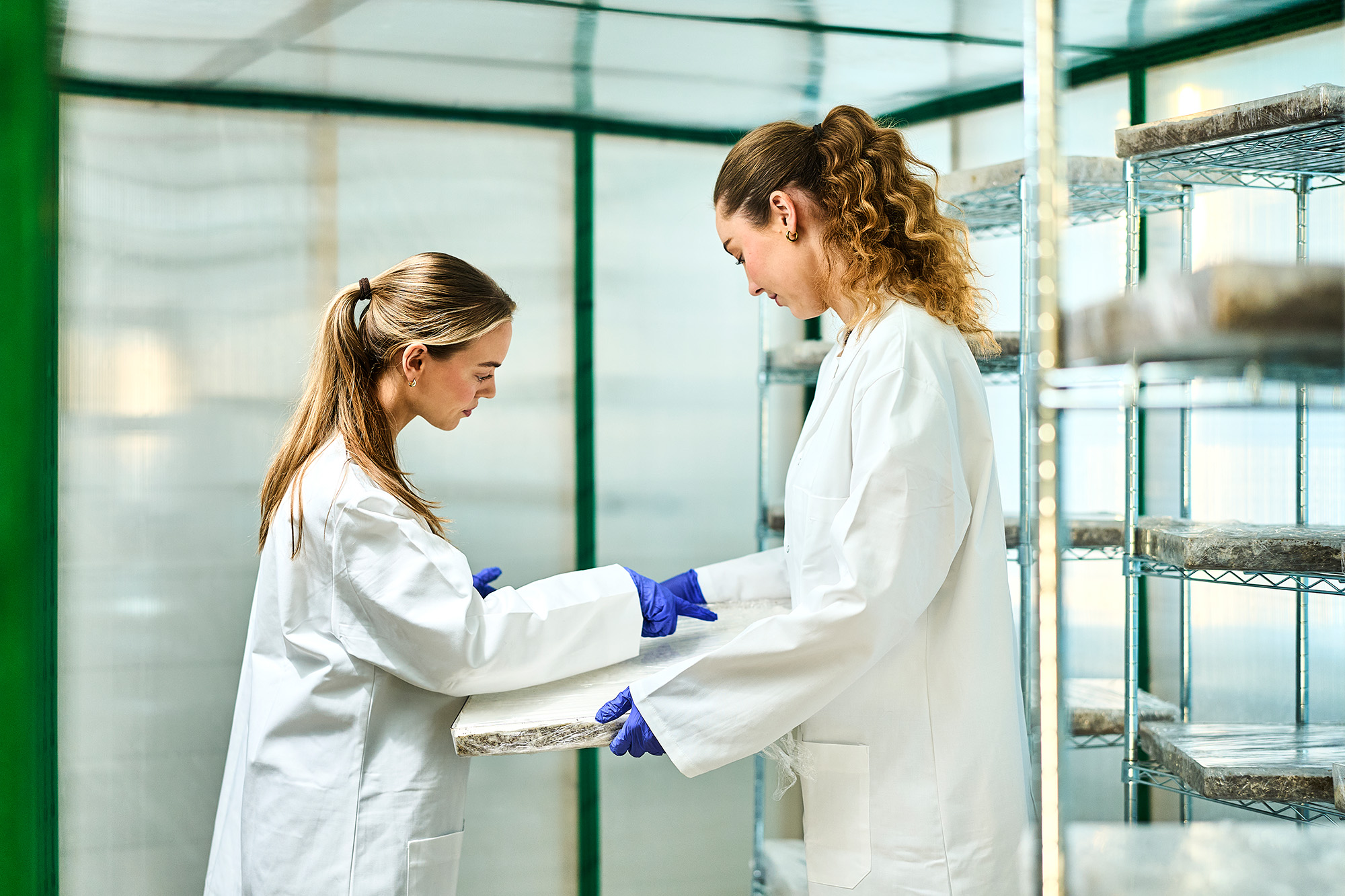
After a few hectic months of intense development of both product and company, the three entrepreneurs have established a production facility in Orkanger, which they describe as a mixture of laboratory and greenhouse. Here, they mix mature mycelium with wood waste from furniture makers and sawmills in the area, fill plastic molds with the mass and let the fungus do the hard work. After a few weeks in the right environment, the wood scraps have been enveloped by the cell threads, and the fungus has created a membrane that is both flame retardant and soundproof. The job is done. “Finally, we heat treat the panels to stop biological growth,” says Christiansen.
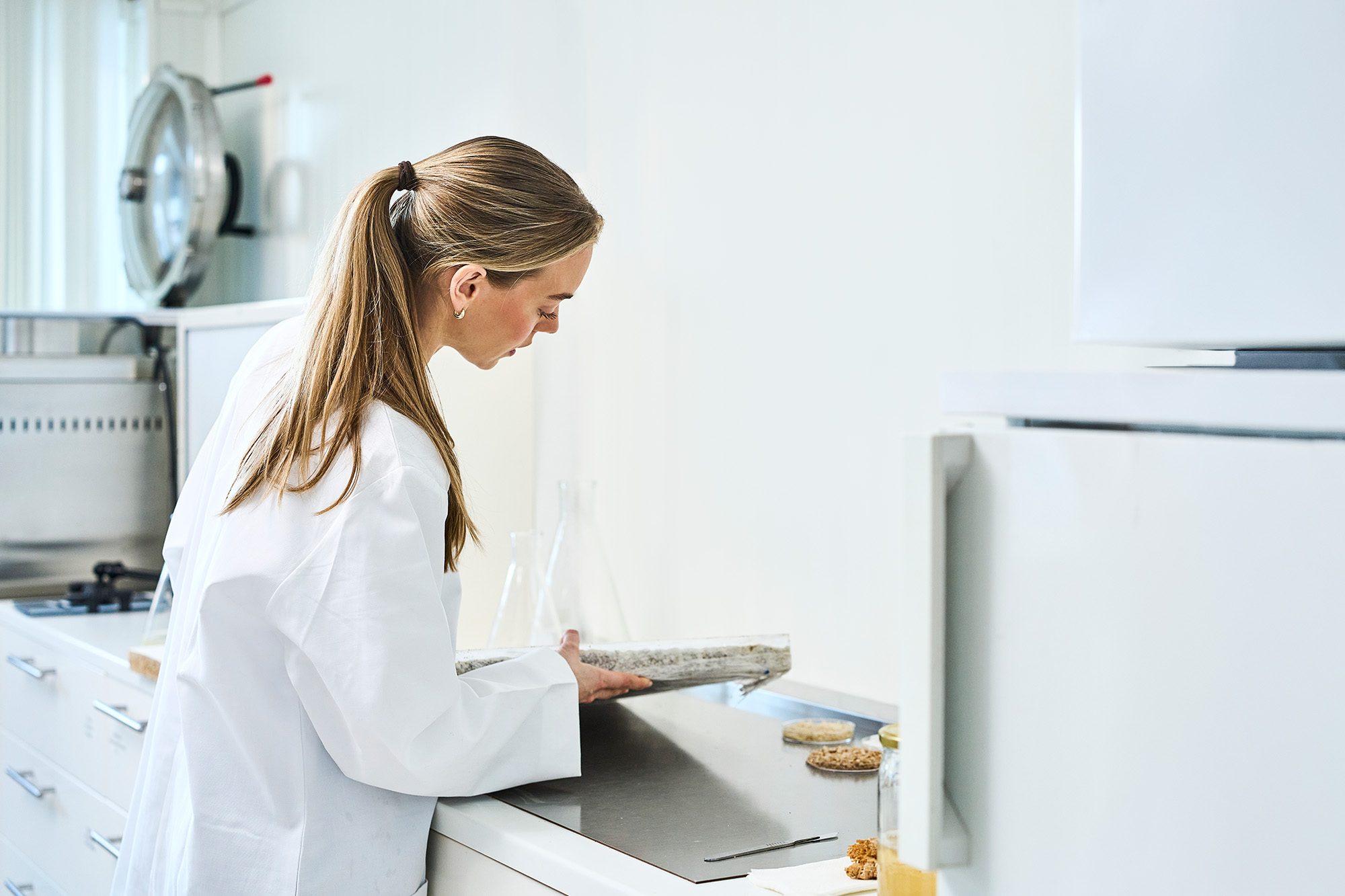
Guro Stålstrøm of Demp examines their acoustic panels, which they hope can replace today’s solutions that are made of glass wool or are petroleum-based.
The result is stylish, functional and sustainable acoustic panels, made from wood waste that would otherwise be thrown away, glued together by living fungi. The production has a quarter of the CO₂ emissions of traditional acoustic panels, which often contain glass wool, petroleum products or concrete. After use, Demp’s panels can be broken down into compost in a few weeks or completely recycled.
The Demp founders believe their acoustic panels can be of great use in a construction industry with increasingly strong demands for sustainability and lower carbon emissions. According to Christiansen, a significant volume of commercial buildings are built and refurbished annually in Norway, where acoustic measures are necessary to meet acoustic requirements.
“We want to land contracts with the largest players,” says Christiansen, “because that’s when we can confirm that this can be big.” But to get contractors like Skanska and Veidekke on the customer list, the acoustic panels need to be certified for both acoustic properties and fire retardancy. “The next step is to obtain certifications and scale up production. We’re now working on raising capital and are in talks with investors to make this happen,” says Stålstrøm.
When they’re not in Orkanger, Christiansen has an office in the Gründerbrakka at NTNU, while Stålstrøm sits in the Gründergarasjen in Oslo. “We are very grateful for the innovation environment in Trondheim. They’ve helped us a lot,” says Christiansen, before they head off to the closing dinner of the 6AM acceleration program.
At the same time in Orkanger, there is at least as much life in another important network, the invisible hyphy threads that are busy producing hundreds of new acoustic panels.
Other news
Reducing costs in the cloud
Companies are moving more and more data and computing power to cloud services such as Azure, Amazon Web Services and Google Cloud. Akif Quddus Khan at the Department of Computer Science has now received NOK 1 million from NTNU Discovery to further develop and test a solution that will reduce the costs of using such services.
Eight million for new main projects
NTNU Discovery awarded almost NOK 8 million to employees and students affiliated with NTNU and Helse Midt-Norge.
Contact us:
Project manager
Jan Hassel
E-mail: jan.hassel@ntnu.no
Phone: 906 53 180
Office: Main building, plinth
Håvard Wibe
E-mail: havard.wibe@ntnu.no
Phone: 41 47 37 68
Office: Main building, plinth